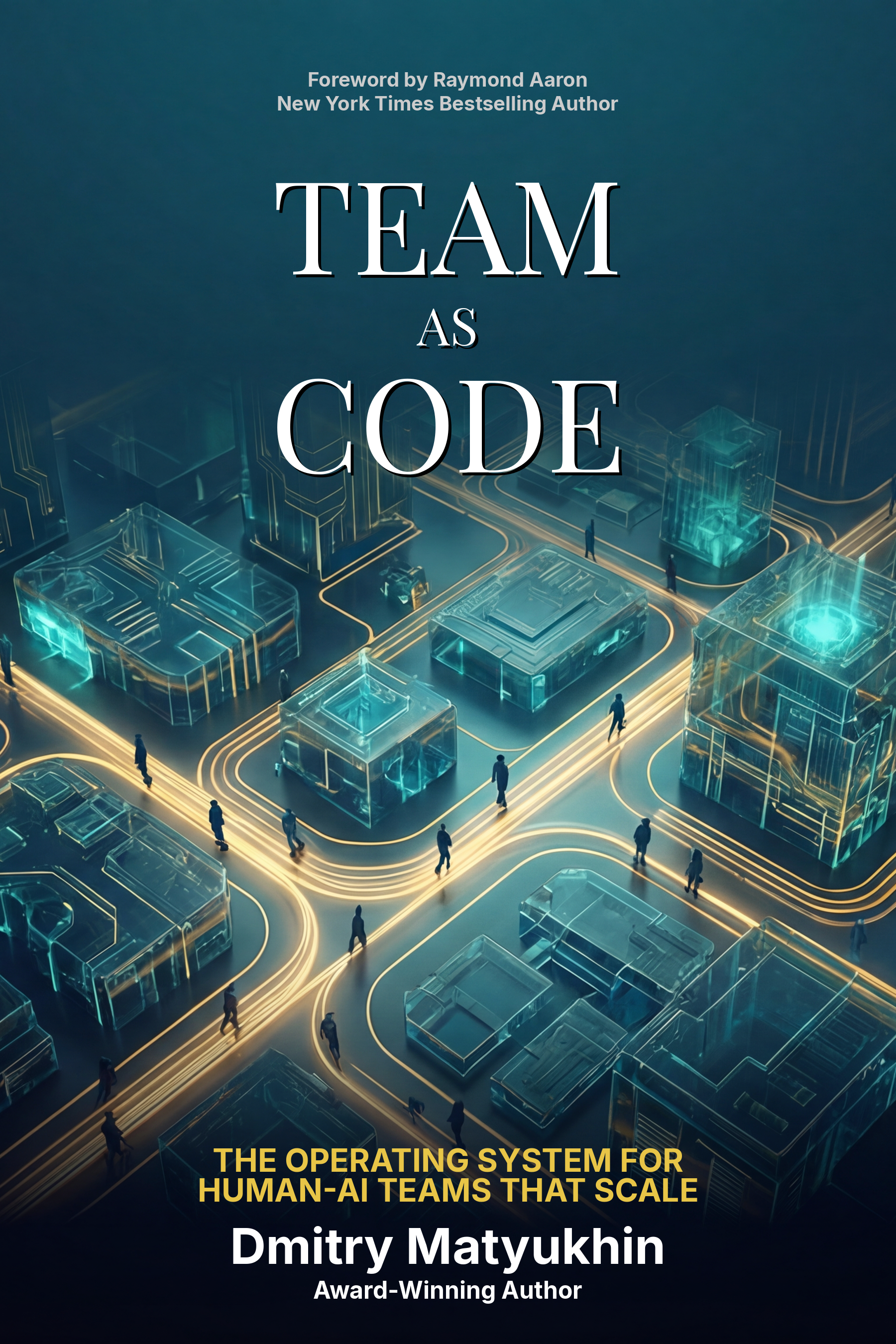
AI agents are ready to take on real work. But they can't absorb culture from watercooler conversations or shadow a senior dev for six months. They need what great software needs — clear interfaces, documented processes, and codified roles.
The Codified methodology applies software engineering principles to how you build and run organizations. So when you're ready to plug in an AI agent, you hand it the same playbook you'd hand a new hire.
That was always inefficient. Now it's a competitive death sentence.
Your software handles server failures gracefully. Your team can't handle someone going on holiday. Your codebase has monitoring, automated alerts, and self-healing mechanisms. Your organization has... Slack threads and WhatsApp groups.
AI agents don't struggle with tasks — they struggle with context. Give them a well-documented role with clear inputs, outputs, and quality criteria, and they perform brilliantly. Give them tribal knowledge and hand-waving, and they're useless. You can't hand an AI agent a watercooler conversation.
Not between companies that have AI and those that don't — everyone will have AI. Between codified organizations and chaotic ones.
Every new AI capability disproportionately benefits organizations that have their operations written down. Codified companies integrate AI agents in weeks. Undocumented companies spend months just figuring out what their processes actually are.
It's compound interest for the systematized and compound irrelevance for the rest.
Apply software engineering principles — version control, modular design, clear interfaces, iterative improvement — to organizational design. Build organizations that work as well as your code.
Separate what needs doing from who does it. Define roles by inputs, outputs, and responsibilities — not job titles. When a role is defined clearly enough, it doesn't matter if it's performed by a person or an AI agent.
Every process, every role definition, every decision — version controlled. Process changes go through pull requests, just like code changes. Full audit trail. Collaborative improvement. No more "that's not how we do things" arguments.
Start with a minimum viable process. Test it in production. Learn from what breaks. Improve iteratively. Don't design the perfect system upfront — you'll never ship it. The first version should be embarrassing. The tenth version should be elegant.
Single responsibility. Clear interfaces between teams. When component A doesn't need to know how component B works internally — only what it receives and what it produces — your organization can scale, refactor, and adapt without everything breaking.
When something goes wrong, you don't fire the server. You trace the bug. Observe, hypothesize, test, fix. Blameless post-mortems. Metrics-driven diagnosis. Treat organizational failures like you'd treat a production incident.
Every role you codify becomes AI-ready. The same documentation that onboards a new hire now onboards an AI agent. The system doesn't care whether the worker is carbon or silicon. That's not the future — that's Tuesday.
Twelve chapters. From the mindset shift to practical implementation. Each one builds on the last. Written in first person, full of real examples, and designed so you can start applying it on Monday morning.
This is the book behind the methodology — the complete guide to applying software engineering principles to organizational design. It covers everything from your first documented process to building hybrid teams where humans and AI agents collaborate from the same codified playbook.
Get notified when it launches — plus early chapters and bonus templates:

I don't just write about this — I build companies this way. ToonStudio.ai is an AI creative platform for animation and game art production. Human artists and AI agents collaborate from the same codified playbook. Every role is defined. Every process is documented and versioned. When we need to scale a capability, we check the role definition and decide: hire a person, or deploy an agent?
The result: creative teams produce animation at scale, with AI handling the volume and humans directing the creative vision. Onboarding takes days, not months. When someone leaves, the knowledge stays — because it was never trapped in their head.
See ToonStudio.ai · InvoiceZap Case StudyLeaders at 15–500 person companies who know their organization should work as well as their product — and want to be AI-ready before their competitors.
Your code scales beautifully. Your team doesn't. You've got monitoring for your servers but not your processes. Time to apply what you already know to how your organization operates.
You built a great product. Now build a great organization around it. Stop firefighting. Stop being the single point of failure. Codify how things work so you can scale without breaking.
Drowning in tribal knowledge. Every departure is a crisis. Every onboarding is a three-month slog. There's a better way — and you already know the principles. They're the ones you use for code.
The methodology is in the book. If you want help implementing it — someone who's done this before, in real companies, at real scale — let's talk.
info@getitcodified.comQuestions about the methodology, the book, or consulting engagements? I read every email.
info@getitcodified.com